
Murrieta, CA · Garage Door Service
Garage Door Service for Perris Homes
Perris homes mostly went up in the late 1990s with steel sectional doors on torsion springs. We service those doors from Murrieta, 15 miles out.
- Repairs & new doors
- Springs & openers
- Serving 6 nearby communities
Where This Job Goes Sideways
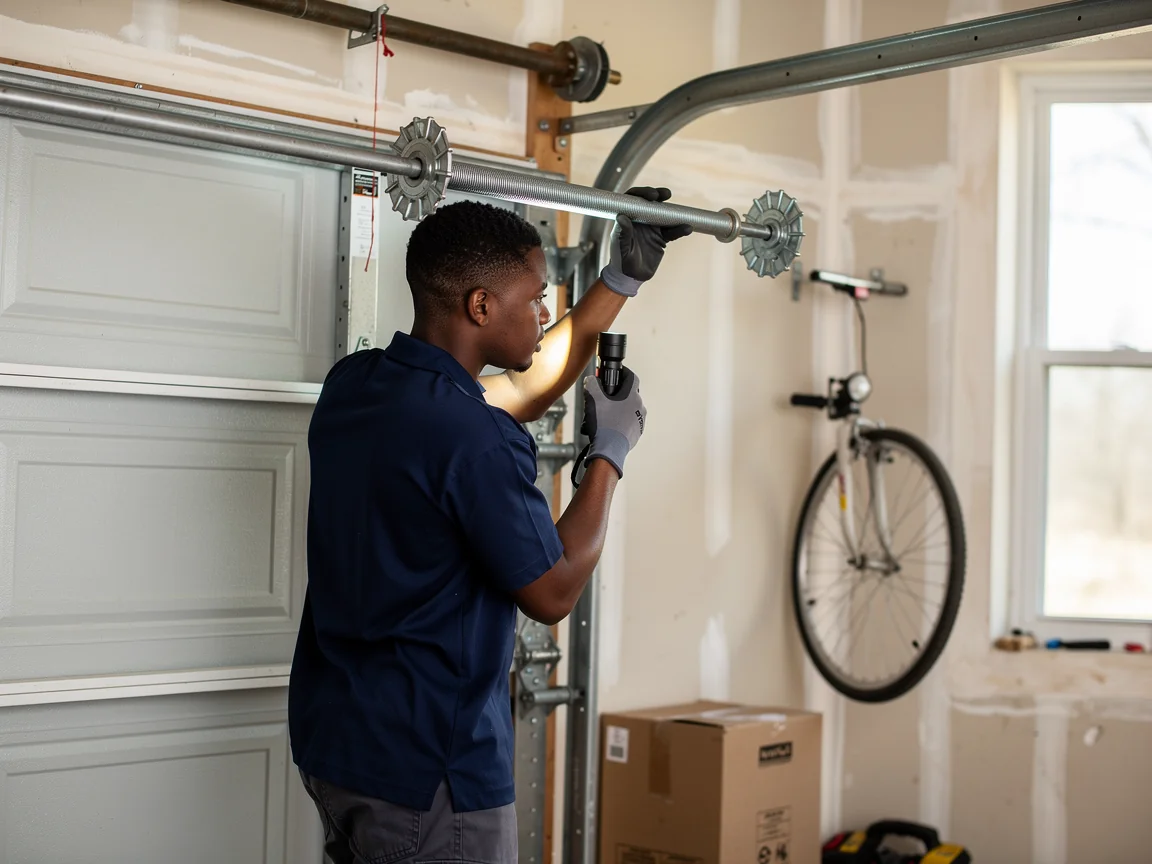
Most houses in this stretch of Perris went up around 1999, which puts the garage doors squarely in the builder-grade steel sectional era - two-car, 16x7, galvanized torsion springs mounted on a single shaft above the opening, with roll-formed steel panels and a thin layer of insulation or none at all. That's a different animal from the older one-piece wood slab doors you'll find in places with pre-1980 stock, and it fails differently. The torsion springs on these doors were wound for 10,000 to 15,000 cycles and a house built in 1999 is well past the point where the factory spring is still doing its job. What we see from this part of the service area is spring fatigue first, then the galvanized coating starting to flake where the coil rubs on itself, then rollers that have gone from nylon to metal-on-metal because nobody ever lubed them. None of that is unique to Perris, but the timing is - a 1999 build means these doors are hitting that failure window now, in a cluster, not spread out over decades like they would be in a mixed-era neighborhood.
Stocked Parts
Because Perris sits in a service area where most of the stock dates to the 1980s and 90s build-out, the torsion springs, rollers, and cable sizes that fail on these doors are common sizes - not oddball parts we have to order. A steel sectional door from 1999 almost always runs standard-wind torsion springs on a 1-3/4 inch shaft, which is what gets carried on the truck. Where it gets slower is hardware that's specific to a door brand that's since changed its bracket spacing or track profile - those jobs sometimes need a part ordered rather than pulled off the shelf, and we'll tell you straight if that's the case before we start. For anything matching the standard torsion setup common to this era of construction, the parts come with us on the first trip out. Full repair details for Perris are on the Perris garage door repair page.
Can You Do This Yourself
A torsion spring under tension on a double door is not a job to learn on your own garage. The spring on a 16x7 door built around 1999 is wound tight enough to break a wrist or worse if the winding bars slip, and the cost of the tool kit to do it safely once isn't worth it for a repair you'll make maybe twice in the life of the house. Rollers, a bent bottom bracket, or a noisy hinge - those are reasonable DIY territory if you're comfortable with hand tools. Realign a track yourself only if the door is light enough to hold steady without the opener fighting you. One honest limit: we come out of Murrieta, about 15 miles from Perris, so this isn't a same-day drop-in the way a shop based in town would be - plan the call, don't wait for the spring to actually snap.
The Cost of This Job
What drives the bill on a Perris garage door job is mostly the door itself - a 1999-era steel sectional with standard torsion hardware is a straightforward repair, while anything custom (insulated panels added later, a retrofit opener, a non-standard track width) adds time. Household income in this part of the service area runs around $82,523, which tracks with the kind of mid-size two-car garage door most of these houses were built with rather than oversized custom doors. We don't publish a flat number here because spring count, cable wear, and whether the opener needs attention too all change the job. What we can tell you up front is whether a repair makes sense versus letting a door that age go to full replacement - sometimes the springs are the only thing worth touching, sometimes the track and rollers are shot enough that fixing just the spring is money spent twice.
How It Shows Up
In this area's moderate heat band, the symptom pattern on a 1999-built door tends to be steady wear rather than sudden cold-snap failure - a spring that's lost tension gradually shows up as a door that the opener strains to lift, or one that slams the last foot instead of settling. You'll hear it before you see it: a grinding or popping sound as a worn roller catches in the track, or a loud bang when a fatigued torsion spring finally lets go. Heat cycling over 25 years also dries out factory lubrication faster than it would in a cooler climate, so a door that's gone quiet on lubrication will start sounding rough well before anything actually breaks. If the door only struggles in the afternoon when the garage has baked all day, that's usually the opener's gears or capacitor, not the spring. For anything matching this pattern, see the Murrieta garage door service page for the broader service list.
Frequently asked questions
Why do Perris garage doors fail around the same time?
Most houses in this part of Perris were built around 1999, so the original torsion springs - rated for a limited number of open-close cycles - are hitting the end of their life in the same general window. It's less about one bad part and more about a whole neighborhood built in the same few years.
Do you have a shop in Perris?
No. We work out of Murrieta, about 15 miles away, and travel to Perris for service calls. We don't claim a local branch or depot here - just a truck that comes out when you call.
Are parts for a 1999 garage door hard to find?
Usually not. A standard steel sectional door from that era runs common torsion spring sizes and standard track hardware, which we typically carry on the truck. Brand-specific brackets or discontinued panel styles are the exception that sometimes needs an order.
Book garage door service in Murrieta
Call now or request a quote - tell us what the door is doing and where you are.