
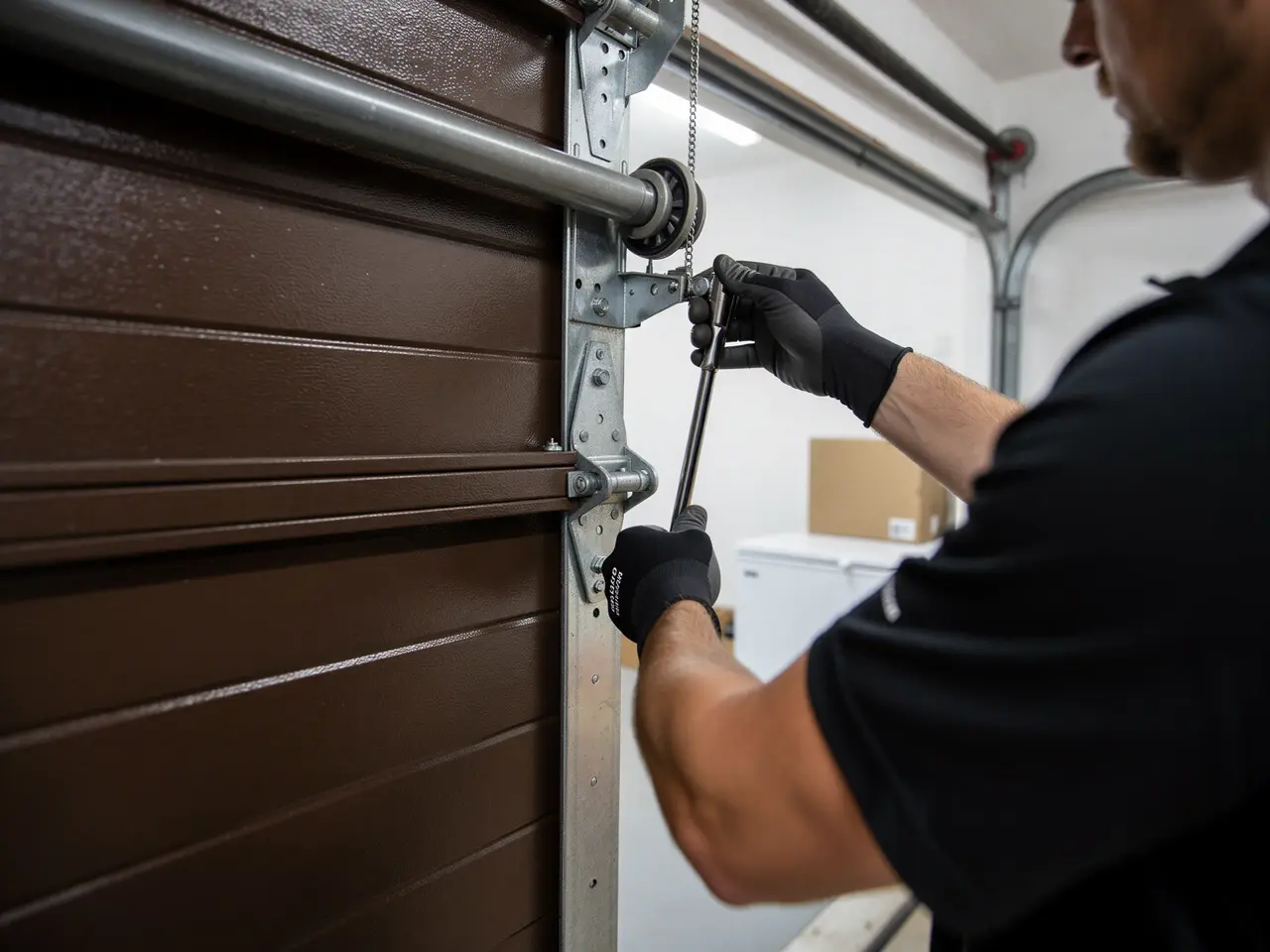
Murrieta, CA · Garage Door Service
Garage Door Repair for Murrieta's 1980s and 90s Housing Stock
Murrieta's garage doors are mostly 1980s and 90s stock with original torsion hardware. Here's why springs, cables, and openers fail the way they do here.
- Repairs & new doors
- Springs & openers
- Serving 6 nearby communities
Where This Job Goes Sideways
Most of the repair calls we get in Murrieta start the same way: a spring lets go on a door that's been running fine for years, and the owner assumes it's a one-part fix. It usually isn't. Housing here was built mostly between 1974 and 2009, with the median build year landing around 1984, which means a huge share of doors in town are still running on the torsion hardware the builder installed the first time. That hardware has a lifespan measured in cycles, not years, and nobody's been counting. When the spring goes, the cable on that side is usually close behind it, and the drum it's wound on has often worn enough that replacing just the spring leaves you back here in six months. The job goes sideways when someone tries to save money on the obvious part and skips the parts that are already halfway gone. We'll tell you straight if a repair is a stopgap. Sometimes it is, and that's fine as long as you know it going in. The honest version of this job is: fix what's failed, inspect what's next to fail, and let the owner decide how much risk they want to carry forward.
Why This Fails Locally
Murrieta sits in a moderate heat band, which doesn't sound dramatic, but it matters for a door that's original to a house built in the 80s or 90s. Daily heat cycling dries out lubricant on tracks and hinges faster than owners expect, and it works on steel springs the same way - expansion and contraction, over and over, for decades. A spring rated for a certain number of cycles doesn't care whether those cycles happened in five years or thirty; it just counts them. Houses in this part of the county were mostly built across a narrow window, 1974 to 2009, which means a lot of doors are aging out at roughly the same time. That's different from a town with a wide mix of build decades, where failures are scattered and unpredictable. Here, we see clusters: a run of 1980s-era torsion springs failing in the same season because they were all installed around the same time and have logged roughly the same number of open-close cycles under the same heat exposure. It's not bad luck. It's the math of a housing stock that aged in step.
How It Shows Up
It rarely announces itself as a spring problem. Owners call about a door that won't open, or one that opens but sounds like it's grinding on the way up, or an opener that strains and then reverses itself halfway through the cycle. On a door with a worn torsion spring, that strain is the opener trying to lift weight it was never built to carry alone - the spring's job is to take most of that load, and when it's gone, the opener motor is doing the work and losing. Cables can fray visibly near the drum before they snap, but most owners never look. Rollers that have gone dry from years of heat exposure make a dragging sound worth paying attention to before they jump the track entirely. With 66,266 owner-occupied houses across this service area, the pattern repeats a lot: a door that worked yesterday and won't lift today is almost never a surprise mechanically, even when it is a surprise to the person standing in the driveway.
The Cost of This Job
With a median household income of $84,369 across the area, most of the jobs we price here are repairs, not full replacements - owners want the door fixed right, not upgraded unless it's actually time. We won't quote a job over the phone without seeing the door; spring tension, drum wear, and opener condition all change what's actually needed, and guessing at that leads to call-backs. What we can tell you is that a repair limited to the failed part costs less than one that also needs a cable, drum, or roller set replaced at the same time - which is common on doors from the 1980s and 90s stock that makes up most of Murrieta. If the springs, cables, and rollers are all near the same age, replacing just one part is sometimes false economy, and we'll say so rather than let you pay for the same service call twice.
Frequently asked questions
Why did my garage door spring break with no warning?
Torsion springs are rated for a set number of open-close cycles, and they don't give much notice before they reach it. In a house built in the 1980s or 90s with the original spring still in place, decades of heat cycling and daily use add up quietly until the spring just lets go, usually on an ordinary lift.
Do you serve areas outside Murrieta itself?
Yes - we work across the surrounding area including Wildomar, French Valley, Canyon Lake, Lake Elsinore, and the smaller communities nearby. If you're within roughly 15 to 20 minutes of Murrieta, give us a call and we can tell you if your address is in range.
Should I replace just the spring or the whole hardware set?
It depends on the drum, cable, and roller condition, which we check on site. If they're original and the same age as the failed spring, replacing everything together usually costs less over time than paying for a second call a year later.
Related services
Related guides
By Neighborhood
Garage Door Repair across the Murrieta area
We also handle garage door repair in these Murrieta-area suburbs.
Book garage door service in Murrieta
Call now or request a quote - tell us what the door is doing and where you are.