
Murrieta, CA · Garage Door Service
Why a Door Goes Off Track in a Murrieta House
Murrieta's 1980s-90s housing stock and warm climate put specific stress on track hardware. Here's why doors jump track here and what actually needs fixing.
- Repairs & new doors
- Springs & openers
- Serving 6 nearby communities
What Local Conditions Do
Most of the houses this company works on went up between 1974 and 2009, with the bulk of that stock dating to the 1980s and 90s, median build year 1984. That matters for one reason: track hardware from that era was galvanized steel on lag-bolted wood jambs, and forty years of door cycles loosens those bolts slowly and predictably.
The climate band here runs moderate heat, not desert-extreme, but a closed garage still swings a wide range between morning and late afternoon. Steel track rails expand and contract with that swing. Over thousands of open-close cycles, the brackets holding the vertical track to the jamb walk a little looser every year. Combine that with a door built in 1984 or 1991 that's never had its track hardware re-torqued, and you get rollers riding closer and closer to the edge of the rail until one hard gust, one fast stop, or one dragging cable finally pushes a roller off the lip.
We cover the ground out to Wildomar and French Valley, both about 5 miles off, Canyon Lake at 9, and Lake Elsinore and Lakeland Village around 12. The pattern repeats across all of it - same build decade, same original hardware, same slow drift.
The Cost of This Job
We don't have a flat number to quote here, and giving you one would be a guess dressed up as a fact. What we can tell you is what drives the number up or down: whether this is a bent section of track that needs replacing, or just bent brackets that need re-anchoring; whether rollers are shot and need swapping out; and whether the door came off track because of something upstream, like a broken cable or a spring that's lost tension and let the door drop crooked.
Across the service area, median household income sits at $84,369, and most owners we talk to make the call on repair-versus-replace based on the age of the door itself, not just the track. A door built when the house went up in the 1980s or 90s is old enough that if the track damage is bad - a crushed rail, a torn-out jamb bracket - it's often not worth sinking money into track repair alone. We'll tell you straight if that's where your door sits before we quote anything.
The Problem
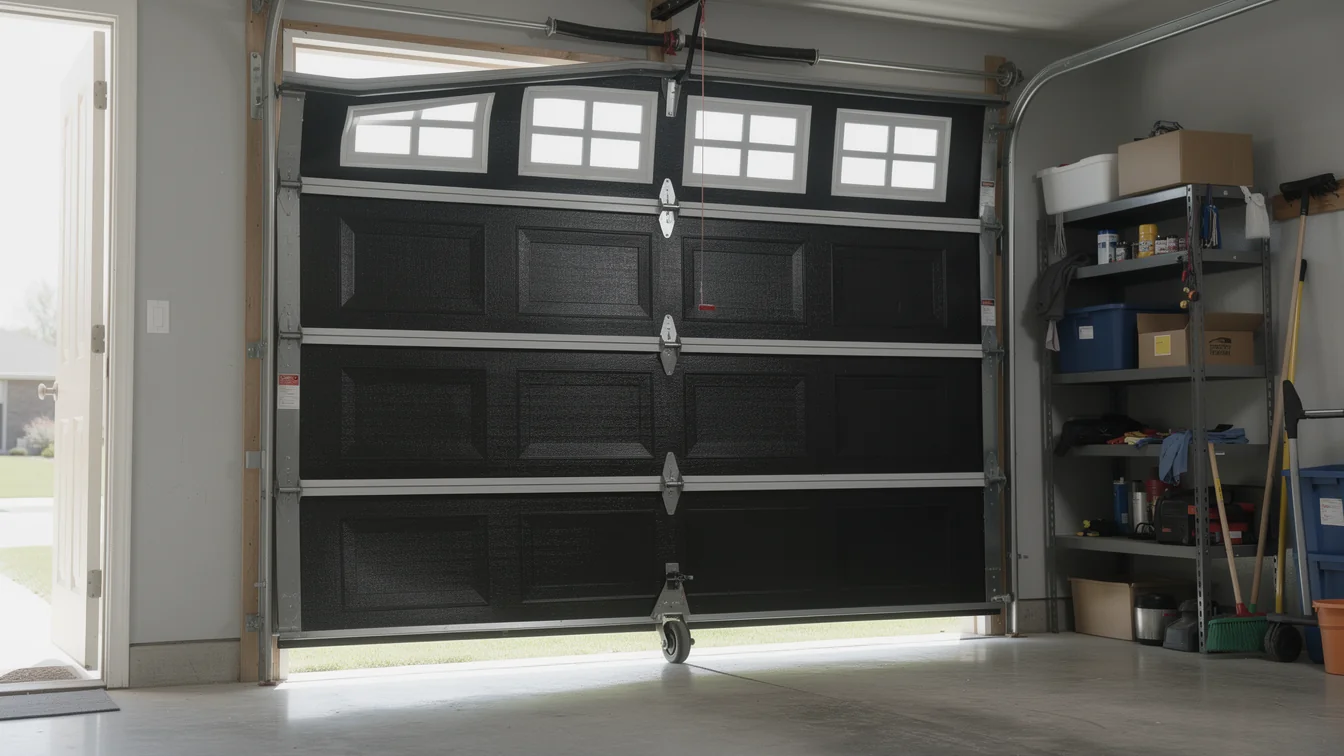
A door doesn't usually jump track on its own. Something pulls it there. The most common version: one roller has been riding loose in a worn track bracket for months, nobody notices because the door still opens, and then one day a cable frays or a spring loses a coil of tension, the door tips slightly as it travels, and that one loose roller finally pops clear of the rail.
The second common version is simpler - a direct hit. Somebody backs into the bottom section, or a storage bin tips into the track from inside, and the rail bends. Once a rail is bent even a quarter inch out of true, every roller that passes the bend gets pushed sideways, and it's only a matter of cycles before one jumps clear.
Either way, the fix isn't just shoving the door back onto the rail. If the bracket that pulled loose from the jamb has been loose long enough, the wood underneath it is often chewed up and won't hold a lag screw the same way twice. That's a repair we check for every time, because resetting a roller into a bracket that's about to pull out again is a callback waiting to happen.
When Waiting Is Fine
Not every noise means the door is about to come off the rail. If the door opens and closes clean, closes flush at the bottom, and the roller noise is a steady rattle rather than a grinding scrape, you can usually wait and get it looked at on a normal schedule rather than treating it as urgent.
The cases where waiting costs you: if you can see daylight between a roller and the track at any point in the travel, if the door visibly leans or racks to one side as it moves, or if one side of the door is clearly riding ahead of the other. Those are signs a bracket or cable has already partly let go, and running the opener on a door in that state is how a simple track reset turns into a cracked panel or a door that drops on someone. If in doubt, run the door by hand with the opener disconnected and feel for resistance or wobble before you decide it can wait.
Frequently asked questions
Why did my garage door suddenly jump off the track?
Usually it's not sudden at all - a roller or bracket has been working loose for months, and a trigger event (a frayed cable, a bump, a spring losing tension) finally lets it jump clear. In houses built in the 1980s and 90s, original track hardware that's never been re-torqued is the usual starting point.
Can I push the door back onto the track myself?
If the door is off track, don't run the opener and don't force the panel back into the rail yourself. Springs under tension can cause real injury, and a door that's riding crooked can crack a panel if you push it the wrong way. Disconnect the opener, leave the door where it sits, and call it in.
Is a bent track always a replace, not a repair?
Not always. A mild bend in a short section of rail can sometimes be straightened or that section swapped out. A crushed rail or one where the jamb bracket pulled out the surrounding wood usually isn't worth patching - we'll tell you which one you've got before quoting anything.
Does Murrieta's climate make this worse than somewhere cooler?
The moderate heat band here means steel track rails see a real daily expansion-and-contraction cycle, which loosens mounting bolts over time faster than it would in a climate with less temperature swing. It's not extreme heat, but it's enough to matter over a door's full lifespan.
Related garage door services in Murrieta
More garage door guides
Book garage door service in Murrieta
Call now or request a quote - tell us what the door is doing and where you are.